
Best Product Research Tools for Dropshipping in 2026: Free, Paid and AI Workflows

On this page
The best product research tools for dropshipping do not replace judgment. They help you move faster from random product idea to evidence-backed shortlist. In 2026, the winning workflow combines free trend tools, marketplace data, ad libraries, paid spy tools, supplier checks, and AI-assisted search.
The goal is not to find a magic product. The goal is to build a repeatable research process: spot demand, check competition, estimate margin, review suppliers, test creative angles, and import only the products that deserve a real product page.
This refreshed guide covers the best dropshipping product research tools by use case, including free tools, paid tools, and Importify's AI Smart Search workflow. It also gives you a scorecard you can use before publishing any product.
Quick answer: best dropshipping product research tools
If you want the short version, use this stack:
- Best free trend tool: Google Trends.
- Best free ad research tool: Meta Ad Library.
- Best short-form creative research: TikTok Creative Center.
- Best marketplace validation: AliExpress Dropshipping Center, Amazon Best Sellers, Etsy search, eBay sold-style research, and niche marketplace reviews.
- Best importer-connected research workflow: Importify AI Smart Search on Premium and Gold plans.
- Best paid spy-tool category: tools like Minea, Dropship.io, Ecomhunt, Sell The Trend, Niche Scraper, and AutoDS product research features.
Do not rely on one tool. A product that looks hot in a spy tool may already be saturated. A product that is rising in Google Trends may have poor supplier quality. A product with strong TikTok engagement may have terrible margins. Use each tool for one job, then combine the evidence.
What product research means in dropshipping
Dropshipping product research is the process of deciding which products deserve a place in your store. It includes demand research, competitor research, supplier research, margin calculation, creative testing, and operational risk checks.
Good research answers these questions:
- Who is the customer?
- What problem, desire, or identity does the product serve?
- Is demand rising, stable, seasonal, or fading?
- How many competitors are already selling it?
- Can the supplier ship reliably to your target country?
- Can you sell it with enough margin after fees, shipping, refunds, and marketing?
- Can you create a product page that feels better than the supplier listing?
Platforms like Importify provide comprehensive lists of marketplaces and suppliers, which helps you research beyond one marketplace. That matters because many beginners get trapped in one supplier ecosystem and miss better products elsewhere.
The product research scorecard
Before looking at tools, use a scorecard. A scorecard keeps you from choosing products because they look exciting in one dashboard.
| Factor | What to check | Pass signal | Reject signal |
|---|---|---|---|
| Demand | Search, social, marketplace and ad activity | Repeated interest across more than one source | Only one viral post or one tool says it is hot |
| Margin | Retail price, supplier cost, shipping, fees, refund buffer | Enough room for profit and marketing tests | Margin disappears after shipping or returns |
| Supplier | Rating, reviews, shipping, variants, communication | Consistent reviews and realistic delivery | Vague shipping, weak images, complaints, counterfeit risk |
| Creative | Can the product be shown clearly? | Easy before/after, demo, problem/solution, or visual payoff | Hard to explain without long copy |
| Operations | Returns, safety, sizing, breakage, support | Low support burden and low regulation risk | Medical claims, fragile goods, sizing disputes, brand risk |
A simple rule: do not import products that fail two or more categories. Importing is easy. Fixing a bad product after customers complain is expensive.
Free product research tools
Google Trends
Google Trends shows search interest by time, region, and related topics. It is useful for spotting seasonality and comparing product categories. Use it to avoid chasing products that already peaked.
Do not treat a Google Trends spike as proof by itself. A spike can mean news, a meme, a seasonal event, or a short-lived trend. Compare the product term with category terms and related queries. A product with stable or rising interest over months is usually safer than a sudden one-week spike.
TikTok Creative Center
TikTok Creative Center helps you explore top-performing ads, trends, and creative patterns on TikTok. For dropshipping, it is useful because many products are sold through short-form visual demonstrations.
Use TikTok to study hooks, objections, visual demos, and comment language. Do not copy the ad. Copying creates weak creative and can create IP issues. Instead, identify why the ad worked: product demonstration, surprising result, strong problem framing, or clear audience match.
Meta Ad Library
Meta Ad Library lets you search active ads across Meta technologies. Meta's own transparency page describes the Ad Library as a searchable database for ads. For dropshipping, it is useful for competitor research and offer research.
Look for advertisers running multiple versions of similar products. Long-running ad patterns can suggest a product or angle is working, but the library does not show full performance data for normal commercial ads. Treat it as directional evidence, not proof.
AliExpress Dropshipping Center and marketplace pages
AliExpress Dropshipping Center can help identify products, analyze marketplace activity, and compare suppliers. Pair it with marketplace pages, customer reviews, star ratings, order signals, and shipping filters.
Marketplace reviews are underrated. Read negative reviews first. They show sizing problems, quality issues, confusing instructions, slow shipping, packaging problems, and support pain. A product with strong demand but repeated quality complaints may not be worth testing.
Built-in store analytics
Your ecommerce platform's analytics become a product research tool once traffic exists. Shopify, WooCommerce, Wix, BigCommerce, and Jumpseller can all show which products get views, add-to-carts, and sales. If your store setup is a bottleneck, outside help such as Shopify website development services can improve the store foundation, but the product data still needs interpretation.
Paid product research tools
Paid tools can save time, especially when they aggregate ads, stores, products, engagement, and sales estimates. The risk is that many sellers see the same "winning product" at the same time. Paid tools are most useful when you use them to find patterns, not when you blindly copy the top product.
Dropship.io and similar store/product databases
Tools in this category help you inspect stores, products, sales estimates, and competitors. They are useful for identifying niches, price ranges, product angles, and store structures. Use them to build a shortlist, then verify products manually.
Minea and ad-spy tools
Ad-spy tools help you inspect ad creatives across channels. They can reveal hooks, formats, landing-page angles, and how aggressively competitors are testing. The danger is copying saturated ads too late. Use ad-spy tools to learn patterns, then create your own positioning.
Ecomhunt, Sell The Trend, Niche Scraper and curated lists
Curated tools are useful when you are new and need a starting point. They often package product ideas with engagement signals, supplier links, suggested pricing, and ad examples. They are less useful if you simply publish the same products as every other subscriber.
AutoDS product research features
AutoDS has product research and automation features, and many sellers compare it with Importify. If you are comparing importer and automation tools, see Importify vs AutoDS. AutoDS is stronger when full automation is the priority. Importify's honest strength is broader marketplace importing across Shopify, Wix, WooCommerce, BigCommerce, and Jumpseller.
Not sure which tool category fits your store? You can also compare the top dropshipping tools.
Where Importify fits in product research
Importify is not only a product importer. It also helps shorten the research-to-listing workflow. You can discover products across supported marketplaces, import the product data, edit the draft, optimize titles and descriptions, set pricing rules, and publish only after review.
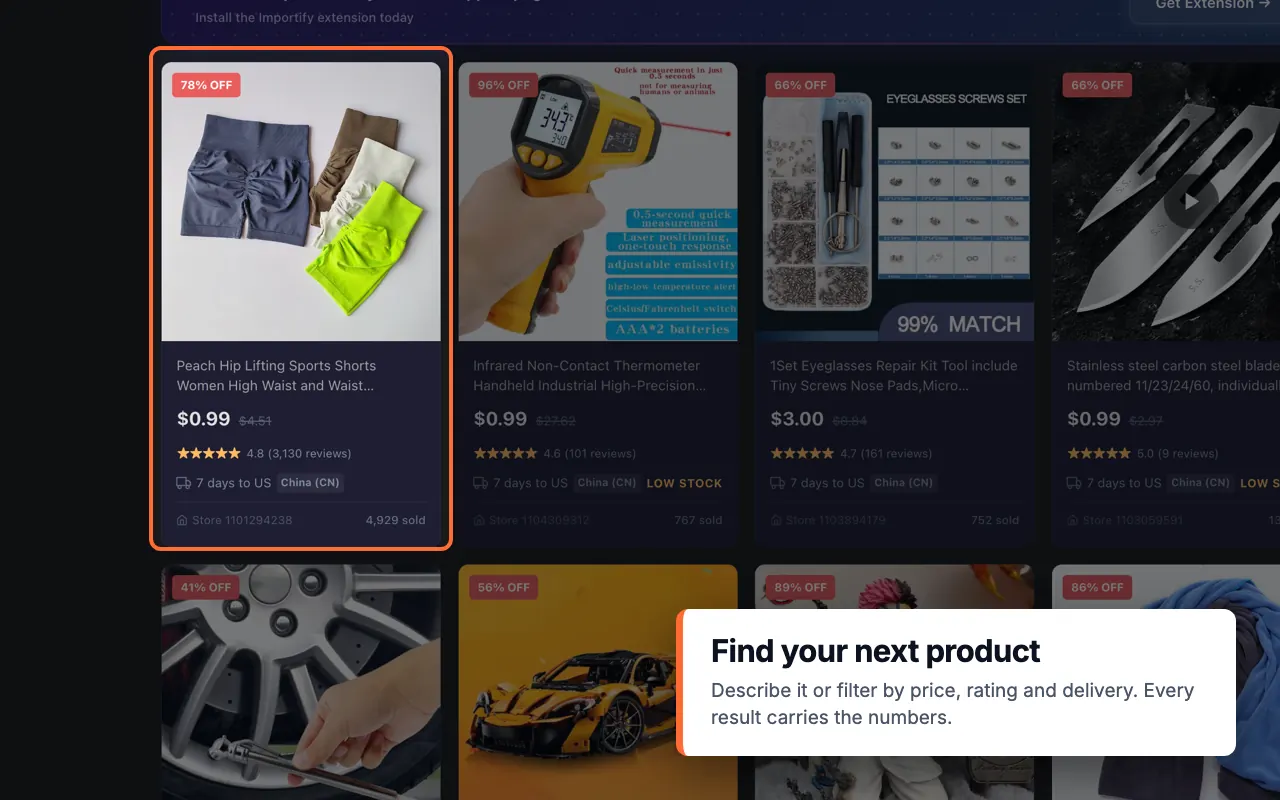
The product research feature to pay attention to is AI Smart Search, available on Premium and Gold plans. Instead of manually browsing one marketplace at a time, you can use smarter search workflows to surface product ideas faster, then validate those ideas with the scorecard above.
Importify's broader value is that it connects research to execution. A product idea is not useful until it becomes a clean product page. Importify helps move from supplier page to editable store draft, where you can rewrite copy, adjust pricing, fix variants, and decide whether the product deserves to go live.
How to use product research tools without fooling yourself
Product research tools can create false confidence. A dashboard can make a product look scientific even when the actual supplier is weak or the market is saturated. Use this workflow to stay grounded.
Step 1: Start with the customer problem
Do not start with "what is trending?" Start with "who has a problem I can serve?" A product that solves a clear problem is easier to position than a random gadget with temporary attention.
Step 2: Find demand from two independent sources
If TikTok shows interest, check Google Trends or marketplace reviews. If a spy tool shows sales, check active ads and supplier reviews. If AliExpress shows orders, check whether competitors are already flooding the product.
Step 3: Calculate margin before importing
A product is not a winner if shipping, fees, refunds, and marketing erase the profit. Estimate landed cost and break-even before writing the page. Low-ticket products with high shipping are often harder than beginners expect.
Step 4: Check supplier quality
Read recent reviews, look at negative feedback, test communication, and review shipping options. If possible, order a sample before scaling. The product page can create demand, but supplier quality determines whether customers are happy.
Step 5: Import as a draft
Use Importify or another importer to save time, but import as a draft. Clean the title, rewrite the description, fix variants, remove weak images, and add FAQs before publishing. Raw supplier pages rarely convert well.
Best tool stack by seller type
Beginner with no budget
Use Google Trends, TikTok Creative Center, Meta Ad Library, marketplace reviews, and organic search. Import a small number of products only after they pass your scorecard. Spend more time writing better product pages than collecting tools.
Beginner with a small budget
Add Importify and one paid research tool if it saves time. Use the paid tool for discovery, then use Importify to move promising products into your store as drafts. Check Importify pricing before choosing a plan.
Intermediate product tester
Use ad-spy tools, store databases, AI Smart Search, and competitor research. Build a weekly product review process. Test fewer products, but test them with better pages, better creatives, and clearer margin rules.
Scaling operator
Use research tools to find product families, supplier alternatives, and bundle opportunities. At this stage, product research is not just about new items. It is also about improving winners, finding backup suppliers, and increasing average order value.
Common mistakes with product research tools
The first mistake is copying tool recommendations without understanding the customer. If every seller sees the same "winner," the winner can become saturated quickly.
The second mistake is ignoring shipping. A product with demand and margin can still fail if customers wait too long or receive poor packaging.
The third mistake is trusting estimated sales too much. Many tools estimate based on visible signals. They are useful, but not perfect.
The fourth mistake is skipping page quality. Product research gets the product into your shortlist. Your product page still has to sell it.
The fifth mistake is not updating research. Product demand changes. Ads fatigue. Suppliers change prices. Research is a weekly operating habit, not a one-time task.
How to turn research into a product testing queue
The biggest benefit of product research is not a single winner. It is a queue of products that can be tested in a controlled order. Without a queue, beginners jump from trend to trend. With a queue, you can compare products using the same criteria and avoid emotional decisions.
Build your queue with four labels:
- Research only: Interesting idea, but not enough evidence yet.
- Supplier check: Demand exists, but shipping, variants, or quality need review.
- Draft page: Product is strong enough to import and rewrite, but not yet live.
- Test live: Page is complete, margin is acceptable, and you have a traffic angle.
This keeps your store cleaner. Instead of publishing every idea, you move products through stages. A product can be rejected at any stage. That is good. A rejected product saves time, ad spend, support work, and refund risk.
When a product reaches the draft page stage, use Importify to bring the product into your store, then review it before publishing. This is where the workflow matters: importing should make the research process faster, not less disciplined. A good importer helps you create drafts quickly, while a good operator decides what deserves to go live.
If your bottleneck is writing cleaner product listings, review Importify features before choosing a plan. The AI Product Optimizer can help turn supplier titles and descriptions into more useful product copy, but you should still verify every product claim, delivery promise, variant, and image.
When a product research tool is worth paying for
Pay for a research tool when it saves more time or prevents more mistakes than it costs. A paid tool is worth considering if you are reviewing products every week, comparing competitors, tracking ad patterns, or managing more than one store. It is usually not worth paying for if you have not yet learned how to judge demand, margin, and suppliers manually.
A practical test is simple: can you name the decision the tool improves? If the answer is "it finds winners," you are probably expecting too much. If the answer is "it helps me compare ad angles, identify stores in my niche, and build a shortlist faster," the tool may be useful.
For many beginners, the best first paid workflow is not a pure research tool. It is a research-to-execution setup: find product ideas with free tools, use an importer to create editable drafts, rewrite the pages, and test only the strongest ideas. That keeps the store from becoming a graveyard of copied supplier listings.
Final recommendation
Use free tools first to understand demand and language. Add paid tools when they save time or reveal patterns you cannot find manually. Use Importify when you are ready to turn research into clean product drafts across supported marketplaces and platforms.
The best product research tool is the one that improves your decision quality. A tool that makes you import more weak products is not helping. A tool that helps you say no faster is valuable.
Frequently Asked Questions
What are the best product research tools for dropshipping?
The best tools include Google Trends, TikTok Creative Center, Meta Ad Library, AliExpress Dropshipping Center, marketplace reviews, Importify AI Smart Search, and paid tools such as Minea, Dropship.io, Ecomhunt, Sell The Trend, Niche Scraper, and AutoDS product research features.
Are free product research tools enough for beginners?
Yes, free tools are enough for the first validation stage. Use them to understand demand, customer language, competitor ads, marketplace reviews, and seasonality. Add paid tools only when you know what information you are missing.
Can product research tools guarantee a winning product?
No. Product research tools improve decision quality, but they cannot guarantee sales. Supplier quality, page copy, pricing, shipping, creative angle, customer trust, and timing still matter.
How often should I do product research?
Do product research every week if you are actively testing. Review trends, competitors, supplier prices, customer comments, and product-page performance. Research is an operating habit, not a one-time setup task.
How does Importify help with product research?
Importify helps connect research to execution. You can discover and import products from supported marketplaces, create editable product drafts, rewrite titles and descriptions, adjust pricing, clean variants, and publish only after review.