
How to Find Winning Dropshipping Products in 2026
On this page
Winning dropshipping products are not random viral items. They are products with clear demand, a believable customer problem, a supplier you can trust, room for profit after shipping and ads, and enough content potential to sell through a real store. Importify helps after you find those ideas by letting you import products from supported suppliers, customize the listing, set pricing rules, and prepare the product for Shopify, Wix, WooCommerce, BigCommerce, or Jumpseller.
If you are a beginner, the goal is not to predict the next huge trend perfectly. The goal is to build a repeatable research process that filters weak ideas quickly and gives the strongest ideas a fair test. This guide shows you how to find winning products for dropshipping in 2026 using free research tools, marketplace signals, social trend data, competitor research, supplier checks, and a practical scorecard you can use before importing anything into your store.
Quick Answer: How Do You Find Winning Products for Dropshipping?
Find winning dropshipping products by combining five checks: demand, problem strength, profit margin, supplier reliability, and marketing angle. A product that scores well on only one of those is usually risky. A product that scores well across all five is worth importing, improving, and testing with a focused product page or small ad campaign.
A simple beginner workflow looks like this:
- Choose a niche or customer group before searching for products.
- Collect product ideas from marketplaces, Google Trends, TikTok, Pinterest, Amazon Best Sellers, reviews, forums, and supplier catalogs.
- Remove ideas with poor margins, obvious quality risk, restricted claims, fragile shipping, or heavy saturation.
- Score the remaining ideas using demand, competition, margin, supplier, and content potential.
- Import a short list, rewrite the title and description, set pricing rules, and test with real traffic.
This process is slower than copying whatever is trending today, but it produces better decisions. A winning product is not just something people watch in a video. It is something your store can sell profitably, support honestly, and differentiate from every copy-paste competitor.
What Makes a Dropshipping Product a Winner?
A winning product has a reason to exist in a customer's life. It solves a specific problem, improves a routine, helps someone express an identity, supports a hobby, saves time, or creates a giftable moment. Products that are merely cheap, strange, or "viral" often fail because shoppers can understand them but do not need them.
Use these traits as your first filter:
- Clear problem or desire: The product should fix something annoying, make a hobby easier, improve comfort, organize a space, enhance appearance, or create a satisfying gift.
- Easy to explain: A customer should understand the use case in a few seconds from the title, image, or short video.
- High perceived value: The product should look more valuable than its sourcing cost after you improve the listing, images, bundle, or offer.
- Healthy margin: Leave room for product cost, shipping, payment fees, returns, discounting, and marketing. A 30 percent margin can be too low if paid ads are your main channel, so model the full cost per order before you import.
- Reliable fulfillment: The supplier should have strong reviews, accurate variants, clear shipping options, and enough order history to trust.
- Content potential: The product should be demonstrable in a short video, comparison, before-and-after example, checklist, gift guide, or problem-solving article.
- Low legal and claim risk: Avoid products that require medical claims, safety guarantees, trademarked branding, regulated ingredients, or unclear certifications unless you fully understand the rules.
The strongest dropshipping products usually sit between boring commodity and impossible novelty. A plain USB cable is too easy to compare on price. A mysterious miracle health device is too risky. A compact desk organizer for remote workers, a pet grooming helper with clear photos, or a travel accessory that solves a packing problem is easier to explain and easier to test.
Start With the Customer, Not the Product
Beginners often open a supplier marketplace and scroll until something looks exciting. That is backwards. Start with a customer segment, then look for products that solve their repeated problems. This makes your store easier to position and keeps you from building a random catalog of unrelated items.
Good customer-first prompts include:
- What does this person buy repeatedly?
- What do they complain about in reviews or forums?
- What are they already trying to improve, protect, organize, decorate, repair, or gift?
- What seasonal moments affect them?
- What accessories do they need after buying a bigger product?
For example, "pet products" is broad. "Apartment dog owners who need easier cleaning and storage" is more useful. It points you toward washable mats, compact grooming tools, odor-control accessories, travel bowls, storage containers, and safety items. Every product idea can be judged against the same buyer, which makes product pages, bundles, email offers, and content more consistent.
Where Can You Find Products for Dropshipping?
You can find product ideas in supplier marketplaces, large retail marketplaces, social platforms, search trend tools, competitor stores, review sections, and offline retail shelves. The mistake is treating any one source as proof. Amazon can show demand, but it can also show heavy competition. TikTok can show attention, but not necessarily purchase intent. Supplier catalogs can show availability, but not market fit.
Use multiple sources together:
- Supplier marketplaces: Use platforms like AliExpress, Alibaba, DHgate, 1688, Temu, Etsy, and other supported sources to understand product availability, variants, shipping options, and supplier quality.
- Marketplace rankings: Amazon Best Sellers can help you see what categories are already moving. Treat rank as a directional category signal, not exact proof that a product will work in your store.
- Search trends: Google Trends helps compare search interest by term, time, and region. Google notes that Trends data is normalized, so use it for direction and comparison, not exact search volume.
- Social trend tools: TikTok's Creative Center trends and Pinterest Trends can reveal rising themes, seasonality, and visual product angles.
- Reviews and forums: Reviews show what buyers love, what breaks, what confuses them, and what they wish existed.
- Competitor stores: Competitors reveal pricing, bundles, ad angles, product-page structure, and positioning gaps. You can look under the hood of a competitor’s store to see the platform and apps behind it.
With Importify, you have access to a comprehensive list of marketplaces and suppliers, which makes the research process easier once you have a shortlist. The tool should not replace judgment. It should speed up the movement from validated idea to editable product listing.
How to Find Winning Products for Dropshipping Free
You do not need expensive research software to build your first shortlist. Paid tools can save time, but beginners can learn faster by doing the research manually first. Free research also teaches you what real demand looks like instead of trusting a tool score you do not understand.
1. Use Google Trends to Check Direction
Google Trends is useful for spotting whether interest is rising, falling, seasonal, or region-specific. It is not a sales calculator. A product can have low search volume but strong social demand, and a product can have rising searches but impossible competition. Use it as one signal.
Search the product name, the problem it solves, and related category terms. Compare alternatives. For example, compare "travel jewelry organizer," "jewelry travel case," and "anti-tangle necklace holder." If one phrase is rising in your target country while another is flat, that tells you how customers describe the product.
Look for three useful patterns:
- Stable evergreen demand: Interest stays consistent across the year. These products are easier for beginners because demand is not tied to one short event.
- Predictable seasonality: Interest rises before holidays, summer, back-to-school, winter, or wedding season. These products require earlier planning.
- Emerging demand: Interest is rising from a small base. These can be good tests, but they need fast validation because trends can fade.
2. Read Bad Reviews Before Good Reviews
Bad reviews are product research gold. They show what customers wanted but did not receive. Read one-star to three-star reviews on Amazon, AliExpress, Etsy, Walmart, and niche stores. Look for repeated phrases like "too small," "broke after a week," "instructions unclear," "shipping took too long," "does not fit," or "wish it came with..."
Those complaints help you find better versions of the same product, write clearer product pages, build comparison tables, and avoid suppliers that create support problems. A winning product is often not a brand-new idea. It can be a better-positioned version of an existing product with clearer sizing, better photos, a useful bundle, or a more honest promise.
3. Watch TikTok and Pinterest for Use Cases
Social platforms are useful because they show how products are demonstrated. A product that needs a long explanation can still work, but it is harder to sell through short-form content. When you review TikTok or Pinterest trends, do not just ask "Is this product popular?" Ask "Can I show this product solving a problem in five seconds?"
Strong content signals include repeated demos, comments asking where to buy, videos showing before-and-after results, creators comparing similar items, and products that fit a clear lifestyle scene. Weak signals include views driven only by shock value, jokes, fake demonstrations, or claims that would be difficult to support on your product page.
4. Scan Amazon Best Sellers, Then Move Deeper
Amazon Best Sellers can help you identify active categories, but the top items are often too competitive. Instead of copying the number-one product, drill into subcategories. Look for accessories, refills, organizers, replacement parts, and complementary products. The money is often in the product next to the obvious bestseller.
For example, if kitchen storage is strong, do not stop at generic containers. Look at drawer-specific organizers, fridge labels, cabinet risers, spice solutions, travel containers, or small-space bundles. If fitness recovery is strong, look beyond massage guns into replacement heads, stretching aids, travel cases, posture tools, or recovery accessories.
5. Check Supplier Catalogs With a Narrow Prompt
Supplier marketplaces become more useful when your prompt is specific. Instead of searching "home products," search for "small apartment storage," "desk cable organizer," "pet hair remover couch," or "travel makeup organizer." Specific searches reduce noise and reveal products with clearer customer intent.
When you find an idea, open several supplier pages for the same product. Compare images, variants, shipping options, order volume, review quality, and store history. If only one weak supplier carries the product, it is not ready. If several strong suppliers carry similar versions, you have backup options and a better chance of maintaining fulfillment.
The Winning Product Scorecard
Use this scorecard before importing a product. Give each category a score from 1 to 5. A product that scores 35 or higher is worth deeper validation. A product between 25 and 34 needs caution. A product below 25 is usually not worth testing unless you have a unique audience or content angle.
| Factor | What to Check | Strong Signal |
|---|---|---|
| Problem strength | Does it solve a real annoyance or desire? | Customers already search, complain, or ask for the solution. |
| Demand | Do marketplace, search, or social signals support it? | Multiple sources show interest, not just one viral post. |
| Margin | Can you price it profitably after shipping and ads? | There is room for fees, discounts, returns, and acquisition cost. |
| Supplier quality | Are reviews, variants, photos, and shipping believable? | Several suppliers offer consistent versions with clear details. |
| Competition gap | Can you improve the offer or positioning? | Competitor listings are weak, generic, confusing, or under-bundled. |
| Content angle | Can you demonstrate it quickly? | It works in a short video, comparison, guide, or before-and-after. |
| Risk | Does it avoid fragile, regulated, branded, or claim-heavy issues? | The product is simple to ship and does not require risky promises. |
| Repeat or bundle potential | Can it lead to more items? | There are accessories, refills, upgrades, or natural bundles. |
The scorecard keeps you honest. Beginners often overrate products they personally like. Scoring forces you to explain why the product deserves a test. It also helps you compare very different ideas, such as a pet grooming tool, a kitchen accessory, and a phone holder, without relying on instinct alone.
How to Check Profit Before You Import
A product is not winning if the math does not work. You need to estimate margin before you build the page. Start with landed cost: product cost plus shipping cost. Then add payment processing, platform fees, app costs, expected discount, packaging or handling if relevant, and a reasonable return allowance.
Use this simple formula:
Expected profit = selling price - product cost - shipping - payment fees - marketing cost - return allowance.
If you plan to sell mostly through organic content, you may tolerate lower immediate margin while you build traffic. If you plan to use paid ads, you need more room because customer acquisition can consume profit quickly. A cheap product is not automatically easier. If an item costs $3 and sells for $9, a small shipping or ad cost can erase the entire margin. A $14 product that can sell for $39 with a strong bundle may be healthier.
This is where Smart Pricing Rules matter. With Importify, you can set fixed or percentage-based margins, price rounding, shipping and fee adjustments, cost-range rules, and preview pricing before import. That helps you avoid publishing products that look good in the catalog but fail once real costs are included.
How to Validate Supplier Quality
Supplier quality is part of the product. If the product arrives late, breaks easily, has mismatched variants, or ships with confusing details, the customer blames your store. Do not treat supplier checks as a final detail.
Before importing a product, check:
- Recent reviews: Recent feedback matters more than old volume. A supplier can decline over time.
- Photo reviews: Buyer photos help confirm what the product looks like outside supplier images.
- Variant clarity: Make sure colors, sizes, bundles, plugs, materials, and quantities are not confusing.
- Shipping options: Avoid products where delivery estimates are vague or too slow for your market.
- Communication: Message suppliers with a real question before scaling. Slow or unclear replies are a warning.
- Backup suppliers: Try to identify at least one alternate supplier before running serious traffic.
Also think about product type. Fragile glass, liquids, cosmetics, electronics with unclear certifications, baby safety items, and medical-adjacent products can create higher support and compliance risk. Beginners should usually start with simple, lightweight, non-regulated products that are easy to explain and easy to ship.
How to Use AI Smart Search Without Guessing
AI can speed up product discovery, but it should not replace validation. Importify's AI Smart Search, available on Premium and Gold plans, lets you describe what you want and discover product ideas inside Importify. The better your prompt, the better your shortlist.
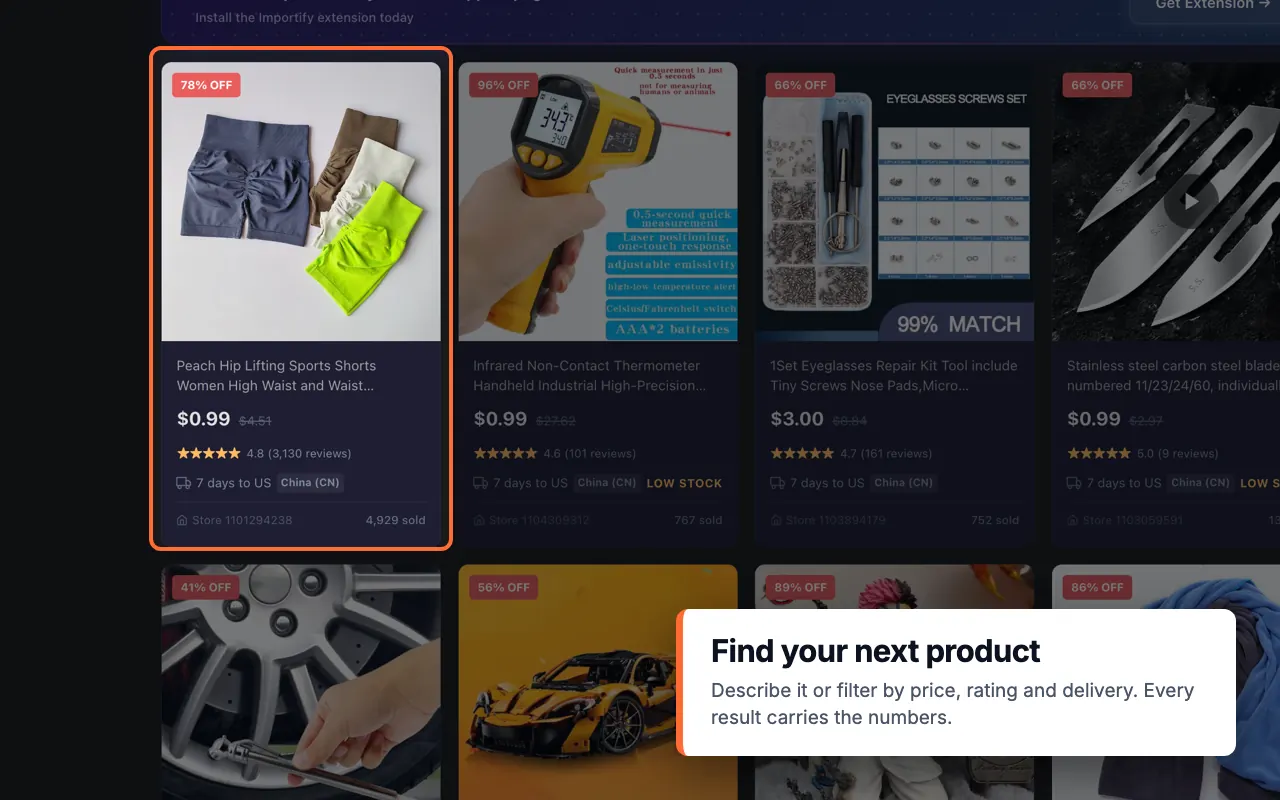
Weak prompt: "Find winning products."
Better prompt: "Find lightweight products for apartment dog owners that solve cleaning, storage, or travel problems, can be sold under $50, and have clear demo potential."
That kind of prompt gives the system a customer, problem type, price range, and content angle. After AI Smart Search gives you ideas, still run the scorecard. Check Google Trends, review sections, supplier quality, margins, and competitor pages. AI is useful for expanding the idea pool, but the business decision is still yours.
You can also use the AI Product Optimizer on Premium and Gold plans after selecting the product. It uses Importify AI, available on Premium and Gold without your own OpenAI API key, to improve product titles and descriptions. That matters because supplier titles are often keyword-stuffed, awkward, or too generic. Better copy does not turn a bad product into a good product, but it helps a valid product communicate value faster.
For more on product sourcing, pricing rules, product customization, AI Smart Search, and AI Product Optimizer, review Importify's feature overview.
How to Find the Best-Selling Product for Dropshipping
The best-selling product for your store is not always the product with the highest public sales rank. It is the product that fits your niche, margins, supplier access, audience, and marketing skill. A beginner store should not try to beat large retailers on generic bestsellers. It should find a sharper angle.
Use these strategies:
- Look for narrow versions of broad demand: Instead of "water bottle," consider insulated bottles for desk workers, collapsible bottles for travel, or bottles with pet-friendly attachments.
- Find complaint patterns: If many buyers complain that a product is hard to clean, too bulky, or missing an accessory, search for a better version.
- Study competitor pages: Weak descriptions, missing size charts, bad images, and unclear shipping details are opportunities.
- Prefer products with multiple creative angles: A product that can be sold as a gift, problem-solver, travel item, and home upgrade gives you more testing options.
- Plan the second product: If the first product sells, what related item comes next? Winners often become small collections.
Do not confuse saturation with competition. Some competition is useful because it proves demand. Saturation becomes a problem when every seller uses the same image, same title, same price, same ad angle, and same supplier. If you can improve the offer, write a clearer page, bundle logically, target a narrower audience, or create better content, competition may be manageable.
Common Beginner Mistakes
Most product research mistakes come from rushing. A product looks exciting, so the beginner imports it, marks it up, launches a generic ad, and quits when nothing happens. Avoid these traps:
- Choosing only by supplier order count: High order count can mean demand, but it can also mean a crowded market.
- Ignoring shipping reality: A product that takes too long to arrive may create refunds and support issues.
- Copying supplier copy: Supplier descriptions rarely explain benefits clearly. Rewrite them for your customer.
- Using medical or exaggerated claims: Claim-heavy products can create ad rejections, disputes, and trust problems.
- Testing too many products at once: You need enough focus to improve the page, creative, offer, and audience.
- Skipping the numbers: If margin fails before ads, no amount of excitement fixes it.
Product research is not about finding one magical item. It is about building a repeatable process. Your first product may not win. The value is learning how to collect signals, filter weak ideas, and improve each test.
Turning Research Into a Store-Ready Listing
Once a product passes your scorecard, do not publish the raw supplier page. Turn it into a customer-facing offer. That means a clean title, benefit-led description, clear variants, accurate images, shipping expectations, FAQ, and trust elements.
With Importify, you can import product details, images, variants, descriptions, and pricing from supported supplier pages. Then you can edit titles, descriptions, variants, SKUs, pricing, compare-at prices, tags, vendors, and product types before publishing. That workflow matters because the same product can perform very differently depending on how it is presented.
Before publishing, ask:
- Does the title explain the product without stuffing keywords?
- Does the first paragraph say who it is for and why it matters?
- Are dimensions, materials, colors, and quantities clear?
- Does the page answer shipping and return concerns?
- Are images consistent and believable?
- Is the price still profitable after all costs?
Take your dropshipping to the next level with Importify, your go-to dropshipping product importer. Trust us to help you grow your business and discover more product opportunities.
How to Test a Product Without Overcommitting
A product is not validated until real shoppers respond. You do not need to build a massive store around one idea before testing it. Start with a small, structured test.
For organic testing, publish the product page, create short-form content around the problem, post comparison content, answer common questions, and track product-page clicks, add-to-cart rate, and checkout behavior. For paid testing, start with limited spend, one clear audience, and two or three creative angles. Do not change everything at once. If the click-through rate is weak, the creative or audience may be wrong. If clicks are strong but add-to-cart is weak, the product page or price may be the issue. If carts are strong but purchases are weak, shipping, trust, or checkout friction may be the problem.
Keep notes for every test. Record the product source, supplier, scorecard score, selling price, content angle, audience, landing page changes, and results. Over time, those notes become your private research database.
Sourcing from AliExpress? Learn how to import winning AliExpress products with Importify.
Conclusion: Build a Research System, Not a Guessing Habit
The best way to find winning products for dropshipping is to stop looking for shortcuts and start using a repeatable filter. Choose a customer, gather ideas from several sources, check demand, read reviews, validate suppliers, score the product, model the margin, and test with real traffic. A product that survives that process is far more useful than a random viral item someone posted in a list.
Importify can help you move faster once your research points to a real opportunity. Use AI Smart Search to discover product ideas, one-click import to bring products into your store, Smart Pricing Rules to protect margin, Product Customization to clean up listings, and AI Product Optimizer to turn supplier copy into clearer product content. The product still has to earn its place, but your workflow becomes faster and more disciplined.
Frequently Asked Questions
How do you find winning products for dropshipping?
Find winning dropshipping products by combining customer research, marketplace signals, search trends, social content, review mining, supplier checks, and margin modeling. A strong product should solve a clear problem, have visible demand, offer room for profit, come from reliable suppliers, and support a strong marketing angle.
What makes a product a winning product?
A winning product solves a real problem or desire, is easy to explain, has high perceived value, leaves room for profit, can be fulfilled reliably, and gives you enough content angles to sell it. It should also avoid unnecessary legal, safety, or shipping risk.
Can I find winning dropshipping products for free?
Yes. You can use free sources like Google Trends, Amazon Best Sellers, TikTok Creative Center, Pinterest Trends, supplier marketplaces, customer reviews, forums, and competitor stores. Paid tools can save time, but free research is enough to build a strong first shortlist.
How much profit margin should a dropshipping product have?
There is no single perfect margin, but the product must leave room after product cost, shipping, payment fees, returns, discounts, and marketing. If you rely on paid ads, you usually need more margin than an organic-content store because customer acquisition costs can rise quickly.
Should I pick trending products or evergreen products?
Beginners usually do better with evergreen products or predictable seasonal products because they give more time to test and improve. Trend products can work, but they require faster execution and tighter risk control because demand can disappear quickly.
How can Importify help me source winning products?
Importify lets you discover product ideas with AI Smart Search on Premium and Gold plans, import products from 25+ supported marketplaces, customize titles and descriptions, set Smart Pricing Rules, and prepare products for Shopify, Wix, WooCommerce, BigCommerce, or Jumpseller.
What should I check before importing a product?
Check demand, reviews, supplier reliability, shipping options, variants, product cost, expected selling price, competition, content angle, and risk. If the product fails on supplier quality or margin, do not import it just because it looks trendy.
How many products should I test at once?
Start with a small shortlist. Testing three to five products carefully is usually better than importing dozens of random items. Focus gives you enough time to improve product pages, pricing, creative, and audience targeting.